Whereas introductions in quantitative sociology articles follow the hard sciences and typically have either a one-step or two-step introduction, with a stated knowledge gap, research question(s), and thesis statement, qualitative article intros have many more deviations.
I have not seen advice on the internet about different styles of introductions to qualitative articles. This is an attempt to provide a typology of these introduction styles.
To build the typology, I examined 28 substantive, i.e. non-methodology focused, articles from the journal Qualitative Sociology between 2020 and 2025.
From these data I identified five types of introductions to qualitative sociology articles. I don’t have spiffy and pithy category titles for them.
- Typical science format with one or two-step introductions
- Starts with a description of the phenomenon, and then has a more or less typical science format
- Description of the phenomenon, and then has a more or less typical science format — story time variant
- Interesting phenomenon with unclear or delayed knowledge gap
- Story time
Here is the data and my coding:
Here is a graph of these data:
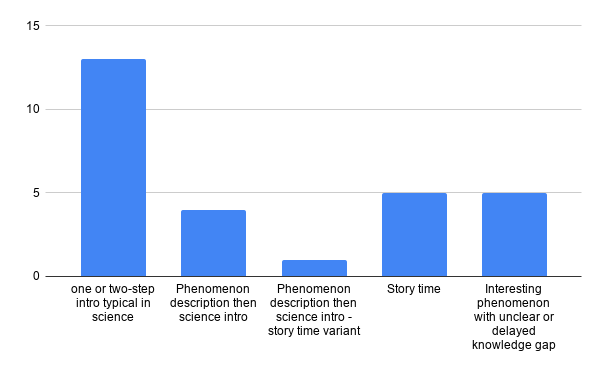
The data and chart indicate that most introductions to qualitative sociology articles follow an introduction style that one would find in quantitative articles. But, it also shows variations. Below, I define them.
Typical science format with one or two-step introductions
These are a one-step or two-step introduction, with a stated knowledge gap, research question(s), and thesis statement, all within the first three paragraphs.
There are many deviations, but they have the main features of typical science introductions. Some deviate from writing standards, with phrases like “to the best of my knowledge” (Czeranowska 2025: 308). Many of them write many paragraphs before they get to the knowledge gap and the research question. Some declare the knowledge gap without citations, and then, a paragraph or so later, rephrase the knowledge gap with explicit reference to the literature. But in the main, they are substantively similar to other scientific articles.
Starts with a description of the phenomenon, and then has a more or less typical science format
The first paragraph starts with a description of an event, e.g. “In September 2017, the central area of Mexico was shaken by two earthquakes which damaged over two thousand historic heritage buildings” (Fridman et al 2025: 184). The author uses event description to concretize the phenomenon in the minds of the reader before heading into a traditional science format.
Description of the phenomenon, and then has a more or less typical science format — story time variant
It starts with a story from the data which serves as a description of the phenomenon, and then more or less gets into a typical science format.
Interesting phenomenon with unclear or delayed knowledge gap
The introduction describes an interesting phenomenon and the author(s) declare that they studied it. There is little reference to the phenomenon in the prior literature, and thus there is no clear knowledge gap.
As a variant, the introduction describes an interesting phenomenon and the author(s) declare that they studied it, but the introduction does not clearly reference the previous literature. The author (may) eventually present a knowledge gap, but it is delayed until deep into the theory section.
Story time
Story time introductions begin with a non-fiction story from their data and maintain that format throughout the introduction. Eventually, many paragraphs later, the authors discuss what the paper is about, and perhaps what the possible contributions might be. This popular “non-fiction magazine” style may not have a clearly stated knowledge gap, and in this way is similar to the “interesting phenomenon” type. Some eventually get to a knowledge gap, but after a subheading that would typically start the theory section, and in any case, not until many, many pages into the article. Some never get there.

