
The building blocks of a social science research article are concepts. The author must present and define all major concepts. Throughout the article, the author must link these concepts together and explain how they relate to one another.
When you think of your article, think of the main concepts and their relationships. All of your writing is about these concepts.
When you are lost in your own paper, go back to your main concepts. They hold the lantern and the key.
The journey of the concepts through the article
In a previous post, we discussed what concepts are and how to choose them: What is a concept? How should we choose a concept?
Concepts are abstract ideas. The social scientist’s job is to choose and define the right concepts, and to show how these concepts fit together.
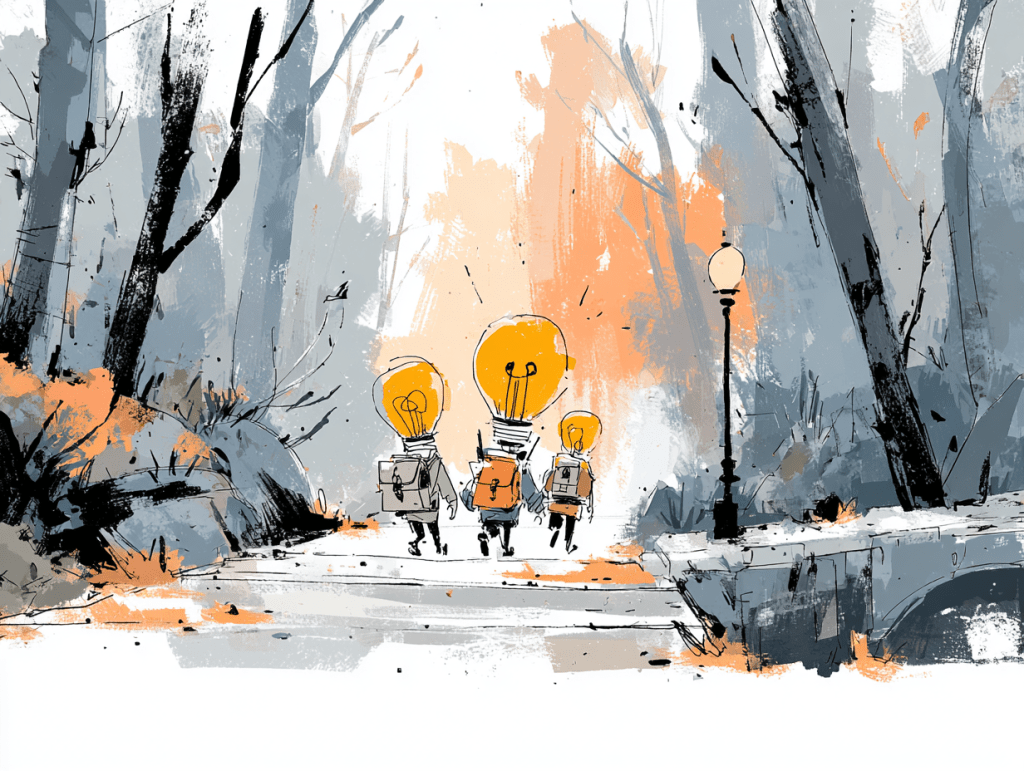
The article is the tale of the concepts’ journey. The structure of the article is the route the concepts follow. Each element of the structure tells a part of the tale.
The title presents the concepts to the audience. The introduction presents the concepts again, briefly defines them, defends why they are important, uses them to ask a question, and poses a thesis (and/or hypothesis) about the relationship between them. Then, the theory section defines the concepts in detail and explicitly shows how the main concepts relate to one another. Next, the methodology section presents how you measure the concepts and how you will analyze their relationships. The results section presents the analyses of the relationships between the concepts. Finally, the conclusion discusses the contribution of the paper to the definition, theory, and measurement of the concepts and their relationships, and posits some directions for the concepts to go for their onward journey. Your references are tales of those concepts’ previous adventures. (And the abstract is a microcosm of the entire article.)
You are the steward of the concepts’ journey. What words you choose to describe the concepts and their relationships to one another shapes how the reader understands them. The references you choose bolsters (or, if chosen badly, undermines) this understanding.

Focus on the concepts
You can solve article writing problems by focusing on concepts.
Problem: “My paper is too long. I don’t know where to cut!”
Diagnosis: You have too many concepts to write about. Or you have too many unnecessary analyses of the concepts.
Solution: Go through your paper’s introduction and theory section and highlight every concept you mention and discuss. You will be amazed at how many words are highlighted. Then, on a separate document, list what you believe to be the top three concepts of your paper. Define these concepts with one sentence each. Write three to four concise sentences about the relationships between these concepts. You are now focused on what is most necessary for your paper — the three main concepts, and their relationships to each other. Look at all the highlighting on your article, and start cutting sentences with unnecessary concepts.
Problem: “I don’t know how to organize my theory section. It looks like a list of article summaries!”
Diagnosis: A theory section is not a literature review. You wrote your theory section like a literature review or a set of notes — just one summary after another, barely organized. You forgot to organize your theory section by concept.
Solution: A theory section is a series of statements about the main concepts and their relationships to one another. Your entire theory section should be organized by concept.
Lead each sentence and each paragraph by concept, not by citation. Go paragraph by paragraph, sentence by sentence. Start most sentences with the concept, not the cite. For example, instead of “Domhall (2019) argued that social norms on altruism influence communication behavior,” write “Social norms on altruism impact communication behavior (Domhall 2019).” Organize each paragraph by concept. The first paragraph should be about social norms. The second paragraph on altruism. The third paragraph on communication behavior. The following paragraph brings it all together.
Problem: “I feel lost in this paper. It seems so disorganized!”
Diagnosis: You have too many concepts to write about.
Solution: Same as when the paper is too long and same as when the theory section is disorganized.

Joshua K. Dubrow is a PhD from The Ohio State University and a Professor of Sociology at the Polish Academy of Sciences.
 The Sociology Place